E-Bike Safety Checklist: Ride Smarter & Safer
E-Bike Safety Checklist: Ride Smarter & Safer
A good E-Bike Safety Checklist helps you catch problems before they become accidents. From checking tire pressure and brakes to wearing the right helmet and charging the battery correctly, a few minutes of preparation can make every ride safer.
Riding an electric bike can make commuting, exercise, delivery work, and everyday transportation faster and more enjoyable. But because an e-bike can accelerate more quickly and travel at higher speeds than a conventional bicycle, basic safety habits become even more important.
This guide covers practical e-bike safety tips, essential safety gear, battery precautions, riding techniques, maintenance checks, and training resources for beginners and experienced riders alike.
Safety note: E-bike laws, speed limits, helmet requirements, age restrictions, and where you can ride vary by country, state, province, and city. Always check the rules that apply where you ride.
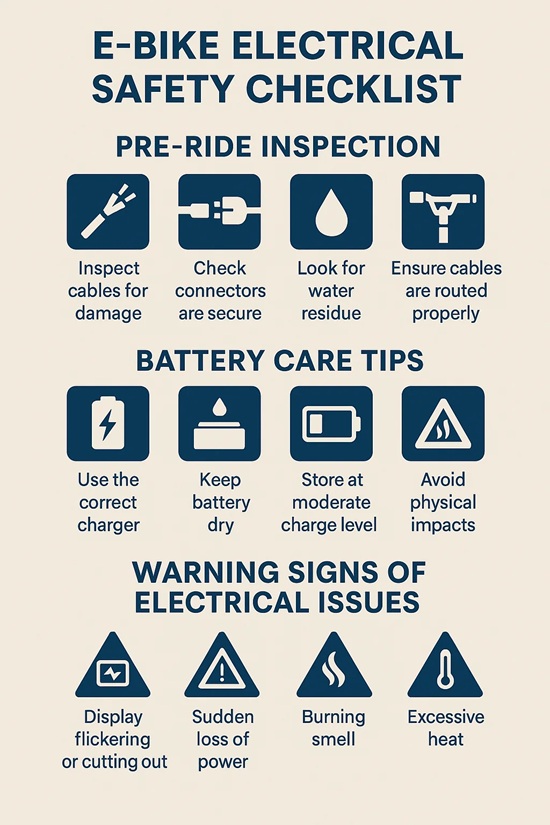
E-Bike Safety Checklist at a Glance
Before every ride, quickly check:
- Helmet fits correctly
- Tires are properly inflated
- Brakes work normally
- Battery is securely installed
- Battery and charger show no damage
- Lights and reflectors work
- Bell or horn works
- Handlebars and seat are secure
- Chain, belt, or drivetrain looks normal
- Throttle and pedal assist respond normally
- Cargo is securely attached
- Phone and other distractions are put away
- You know the route and local riding rules
The U.S. Consumer Product Safety Commission recommends checking components such as the handlebars, brakes, throttle, bell, lights, tires, cables, and frame before riding.
Why E-Bike Safety Matters
E-bikes combine bicycle-style controls with an electric motor and battery system. That means riders need to understand both traditional cycling safety and the additional considerations associated with electric propulsion.
The extra acceleration can be useful when joining traffic or climbing hills, but it can also surprise a new rider.
E-bikes are also often heavier than traditional bicycles. A heavier bike moving at speed requires good brakes, appropriate tires, and enough space to stop safely.
The goal isn’t to make riding complicated. Instead, good e-bike safety is about developing a simple routine that becomes automatic.
1. Start With the Right E-Bike
Safety begins before you even get on the bike.
Choose an e-bike appropriate for your height, weight, experience, intended terrain, and local regulations.
Check the manufacturer’s specifications for:
- Maximum rider and cargo weight
- Maximum assisted speed
- Motor power
- Recommended tire pressure
- Battery specifications
- Brake type
- Intended riding environment
- Minimum rider age, where applicable
Don’t assume that every product advertised as an “e-bike” is legally classified as an electric bicycle in your location. Some high-powered electric two-wheelers may fall under different vehicle regulations.
In the United States, the three-class e-bike system is widely used, but electric-bike laws still vary between states and local jurisdictions.
2. E-Bike Safety Helmets: Your First Line of Protection
A helmet is one of the most important pieces of e-bike safety gear.
The U.S. National Highway Traffic Safety Administration recommends wearing a properly fitted bicycle helmet on every bike ride.
A helmet that doesn’t fit correctly may not provide the intended protection.
How to Fit an E-Bike Helmet
Your helmet should:
- Sit level on your head
- Cover the appropriate portion of your forehead
- Fit snugly without causing painful pressure
- Have straps forming a comfortable “V” around your ears
- Have the chin strap secured
- Stay stable when you move your head
Don’t wear the helmet pushed far back on your head.
If you’re unsure about the fit, consult the manufacturer’s instructions or ask a qualified bicycle shop to check it.
Replace a Damaged Helmet
A helmet that has suffered a significant impact should generally be replaced, even if there are no obvious cracks.
Also inspect older helmets for deterioration and follow the manufacturer’s replacement recommendations.
3. Check Your Tires Before Every Ride
Tires are your connection to the road.
Underinflated tires can affect handling, increase rolling resistance, and increase the likelihood of damaging the rim when hitting obstacles.
Overinflated tires can also reduce comfort and traction.
Check the recommended pressure printed on the tire sidewall or specified by the manufacturer.
Look for These Problems
Before riding, inspect the tires for:
- Cuts
- Cracks
- Embedded glass
- Excessive wear
- Bulges
- Exposed casing
- Low pressure
- Uneven wear
If you frequently ride over potholes, gravel, or rough pavement, inspect your tires more often.
4. Test Your Brakes
Good brakes are essential because e-bikes can travel at relatively high speeds and may be heavier than conventional bicycles.
Before leaving, squeeze each brake lever independently.
The levers should feel firm and predictable.
Watch for:
- Excessive lever travel
- Grinding noises
- Weak braking
- Squealing that suddenly appears
- Damaged brake cables
- Worn brake pads
- Leaking hydraulic fluid
If braking performance changes noticeably, don’t simply compensate by riding slower. Have the braking system inspected.
5. Check the Battery and Electrical System
Battery safety deserves special attention because e-bikes commonly use lithium-ion batteries.
The CPSC recommends using micromobility devices and batteries that meet applicable safety standards and following manufacturer instructions.
Before riding, inspect the battery for visible damage and make sure it is securely mounted.
Never ignore:
- Swelling
- Cracks
- Burning smells
- Unusual heat
- Damaged connectors
- Exposed wiring
- Signs of water or impact damage
If a battery appears damaged, stop using it and follow the manufacturer’s safety instructions.
Recent CPSC warnings demonstrate why battery quality and proper maintenance matter. The agency has issued warnings involving specific e-bike batteries that presented fire hazards.
6. Charge Your E-Bike Safely
Charging is part of e-bike safety, not simply routine maintenance.
Use the charger supplied with your e-bike or one specifically approved by the manufacturer.
The CPSC advises using the manufacturer’s supplied or recommended charger and being present while charging rather than charging while sleeping or away from home.
Safe Charging Habits
- Inspect the battery and charger before charging.
- Use the correct manufacturer-approved charger.
- Charge in accordance with the owner’s manual.
- Keep the charging area clear.
- Don’t cover the battery or charger while charging.
- Keep charging equipment away from water.
- Unplug the charger according to the manufacturer’s instructions.
- Don’t use visibly damaged batteries.
Never modify an e-bike battery or attempt a homemade battery repair unless you’re qualified to perform that work safely.
7. Essential E-Bike Safety Gear
A helmet is essential, but it isn’t the only useful safety equipment.
Recommended E-Bike Safety Gear
Helmet
Choose a properly fitted bicycle helmet appropriate for your riding environment.
Front and Rear Lights
Lights improve visibility, especially at night, during rain, or in low-light conditions.
Reflective Clothing
Reflective elements can make you easier for motorists to identify.
Gloves
Cycling gloves can improve grip and protect your hands if you fall.
Eye Protection
Clear or tinted cycling glasses can protect your eyes from insects, dust, wind, and debris.
Bell or Horn
A bell or audible warning device can help alert pedestrians and other road users.
High-Visibility Clothing
Bright clothing can make you easier to see during daytime riding.
Basic Repair Kit
Carry:
- Spare tube
- Tire levers
- Mini pump
- Multitool
- Patch kit
- Emergency light
You don’t necessarily need expensive equipment. Reliable basics are more useful than gadgets you don’t know how to operate.
8. Learn How Your E-Bike Accelerates
One of the most common mistakes new riders make is treating an e-bike exactly like a traditional bicycle.
Before entering traffic, practice in a quiet area.
Learn how:
- Pedal assist starts
- The throttle responds, if equipped
- Different assist levels feel
- The bike behaves when braking
- The bike handles at low speed
- The motor reacts when you stop pedaling
Start with the lowest assistance level.
Once you understand the bike’s behavior, gradually increase assistance.
This is especially important for heavier cargo e-bikes.
9. Practice Emergency Braking
- Don’t wait for your first emergency to discover how your brakes feel.
- Find a safe, empty area and practice controlled braking.
- Start at low speed.
- Gradually increase your speed while learning how much pressure is required to stop smoothly.
- Keep both hands on the handlebars and avoid grabbing the brakes abruptly while turning.
- Practice braking in a straight line before attempting more complicated scenarios.
10. Follow Traffic Rules
An e-bike is still a vehicle that interacts with pedestrians, cars, motorcycles, and other cyclists.
Follow applicable traffic laws and posted signs.
Depending on your location, this may include:
- Stopping at red lights
- Obeying stop signs
- Yielding appropriately
- Using designated bike lanes
- Signaling turns
- Riding in the correct direction
- Using required lights at night
NHTSA notes that many states treat bicycles as vehicles when they are operated on the road, meaning riders must follow applicable rules.
Don’t assume that because your e-bike has a motor you can ride anywhere a motorcycle can—or assume the opposite.
Always check local rules.
For more related blogs, please click below:
- E-Bike Tax Credits and Rebates by State {2026}
- Best E-Bikes For Food Delivery Riders.
- Electric bicycle.
11. Stay Visible
Visibility is one of the most important e-bike safety tips for riding around traffic.
An e-bike can be relatively quiet, and motorists may not notice you until you’re close.
CPSC recommends using visibility equipment such as reflectors, headlamps, bells, or horns and advises riders to slow down and remain aware of their surroundings.
Improve Visibility by:
- Using front and rear lights
- Wearing reflective elements
- Avoiding blind spots
- Making your intentions predictable
- Using hand signals when appropriate
- Making eye contact with drivers when possible
- Leaving adequate space around vehicles
Never assume a driver has seen you simply because you can see the vehicle.
12. Slow Down at Intersections
Intersections deserve extra attention.
Many collisions happen because road users approach intersections at different speeds or fail to notice each other.
Before crossing:
- Reduce speed.
- Scan left, right, and left again where appropriate.
- Watch for turning vehicles.
- Look for pedestrians.
- Avoid entering another road user’s blind spot.
- Proceed only when the path is clear and legal.
Being right about having priority doesn’t protect you from a collision.
Defensive riding is about anticipating what other people might do.
13. Be Careful on Wet and Slippery Roads
Rain changes braking and traction.
Painted road markings, metal covers, leaves, gravel, and wet pavement can become particularly slippery.
When conditions deteriorate:
- Reduce speed
- Increase following distance
- Brake earlier
- Avoid sudden steering
- Take corners more slowly
- Watch for standing water
- Use appropriate lights
If conditions become dangerous, consider postponing the ride.
14. Keep Both Hands Available
Your handlebars are not a place to hang shopping bags, grocery bags, backpacks, or other loose objects.
CPSC advises keeping both hands on the handlebars and keeping items off them.
Use:
- A rear rack
- Panniers
- A basket
- A properly secured cargo system
If you need to use your phone, stop somewhere safe.
Don’t navigate, text, or scroll while moving.
15. Don’t Overload Your E-Bike
Every e-bike has a maximum weight rating.
That limit may include the rider, passengers, and cargo.
Check the manufacturer’s specifications before carrying heavy equipment.
Overloading can affect:
- Braking distance
- Steering
- Acceleration
- Tire performance
- Frame stress
- Motor performance
- Overall stability
Cargo should also be distributed evenly and secured so it cannot move during riding.
16. E-Bike Safety Training for Beginners
If you’re new to e-bikes, formal e-bike safety training can be extremely useful.
A good course can teach more than simply how to operate the motor.
Look for training that covers:
- Traffic awareness
- Defensive riding
- Helmet fitting
- Braking
- Turning
- Lane positioning
- Intersections
- Battery safety
- Basic maintenance
- Local e-bike regulations
PeopleForBikes, the League of American Bicyclists, and Bicycle Colorado created E-Bike Smart, a rider education program covering e-bike classes, battery charging and storage, helmet fitting, signaling, road and trail etiquette, and pre-ride checks.
PeopleForBikes also identifies rider education as an important part of improving e-bike safety.
17. Perform the ABC Quick Check
A simple pre-ride inspection can help you catch problems early.
The League of American Bicyclists’ ABC Quick Check is incorporated into the E-Bike Smart education program.
A practical version is:
A — Air
Check tire pressure and condition.
B — Brakes
Test both brakes.
C — Cranks, Chain, and Controls
Check the drivetrain, pedals, and control components.
Quick
Check wheels, quick-release mechanisms, and other loose parts.
Check
Take a brief overall look at the bike before riding.
This takes very little time once it becomes a habit.
18. E-Bike Maintenance Is Part of Safety
A well-maintained e-bike is easier to control and less likely to develop mechanical problems during a ride.
Create a regular maintenance routine.
Weekly or Frequent Checks
Depending on how often you ride:
- Check tire pressure
- Inspect brake pads
- Clean the drivetrain
- Check chain lubrication if applicable
- Inspect cables
- Check bolts
- Inspect wheels
- Clean the bike
- Check battery connections
Professional Inspection
If you’re riding thousands of miles per year, consider having a qualified bicycle technician inspect the bike regularly.
High-mileage riders, delivery workers, and commuters should be particularly proactive about wear items such as brake pads, tires, chains, bearings, and drivetrain components.
E-Bike Safety Checklist for Night Riding
Night riding requires additional preparation.
Before leaving, check:
- Front light works
- Rear light works
- Reflectors are present where required
- Clothing has reflective elements
- Battery has enough charge
- Route avoids unnecessarily dangerous roads
- Phone is charged
- You have emergency contact information
- Avoid assuming that street lighting makes your bike sufficiently visible.
- Your own lights should help other road users identify your position.
E-Bike Safety Checklist for Every Ride
Save this checklist on your phone or print it for your garage.
Before Riding
- Helmet fitted correctly
- Tires properly inflated
- Tires free from serious damage
- Brakes tested
- Wheels secure
- Handlebars secure
- Seat secure
- Battery locked into place
- Battery shows no damage
- Lights working
- Bell/horn working
- Drivetrain checked
- Cargo secured
- Phone charged and mounted safely
- Weather checked
- Local riding rules understood
During Riding
- Ride predictably
- Follow traffic laws
- Watch for vehicles and pedestrians
- Maintain a safe speed
- Keep both hands on the handlebars
- Avoid distractions
- Slow down at intersections
- Leave enough stopping distance
- Use lights when required or appropriate
After Riding
- Turn off the e-bike
- Inspect for damage
- Store securely
- Charge according to manufacturer instructions
- Keep the battery and charger away from unsafe conditions
- Report or investigate unusual battery behavior
Common E-Bike Safety Mistakes to Avoid
Even experienced cyclists can develop bad habits.
Avoid these common mistakes:
Riding Too Fast
Higher speed gives you less time to react and generally increases the energy involved in a crash.
Ignoring Brake Wear
Don’t wait until the brakes become dangerously weak.
Riding Without a Helmet
A helmet should be part of your standard riding routine.
Using Cheap or Incompatible Chargers
Use the manufacturer’s recommended charging equipment.
Carrying Loose Cargo
Unsecured cargo can interfere with steering or fall into the wheels.
Riding While Distracted
Never text or manipulate your phone while riding.
Ignoring Local Laws
E-bike regulations can differ substantially between locations.
Assuming Drivers See You
Ride defensively and make yourself visible.
Frequently Asked Questions
Are e-bikes safe for beginners?
Yes, e-bikes can be suitable for beginners when riders learn how the motor, brakes, gears, and controls work before riding in traffic. Start slowly and practice in a low-traffic environment.
What is the most important e-bike safety gear?
A properly fitted helmet is one of the most important pieces of safety gear. Lights, reflective equipment, gloves, eye protection, and appropriate clothing can provide additional benefits depending on where and when you ride.
Should I wear a helmet on an e-bike?
Yes. Wearing a properly fitted bicycle helmet is a fundamental safety practice. NHTSA recommends wearing a helmet for every bike ride.
How often should I check my e-bike?
Perform a quick safety inspection before every ride. More detailed maintenance should be performed according to your riding frequency, manufacturer recommendations, and the condition of individual components.
Can I charge my e-bike overnight?
It’s safer to follow the manufacturer’s charging instructions and avoid charging while sleeping or when nobody is present. CPSC specifically advises consumers to be present while charging micromobility products.
Do e-bike safety laws vary by country?
Yes. Helmet requirements, speed limits, age restrictions, road access, equipment requirements, and e-bike classifications can vary significantly by jurisdiction.
Final Thoughts: Make Safety a Habit
The best E-Bike Safety Checklist isn’t the one you read once—it’s the one you actually use.
Before every ride, take a few minutes to check your tires, brakes, battery, controls, lights, and cargo. Wear a properly fitted helmet, stay visible, obey local traffic laws, and adjust your speed to the road and weather conditions.
For beginners, e-bike safety training can accelerate the learning process and build confidence before riding in busy environments.
Most importantly, don’t treat safety as something that makes e-bike riding less enjoyable. Good safety habits give you more confidence, better control, and a much better chance of enjoying your e-bike for years to come.
Ride prepared, stay visible, respect the road, and make every safety check part of the ride.