Dual Motor Electric Bikes: Complete Guide 2026
Dual Motor Electric Bikes: Complete Guide 2026
If one electric motor is good, why use two?
Dual Motor Electric Bikes answer that question with more traction, stronger acceleration, improved hill-climbing ability, and greater control on difficult terrain. Instead of relying on a single hub motor, these bikes typically use one motor at the front and another at the rear.
That makes them particularly interesting for riders dealing with steep hills, sand, snow, mud, gravel, heavy loads, or off-road trails.
However, more power isn’t automatically better. A dual motor system can increase weight, battery consumption, tire wear, and purchase price. Some high-power models also fall outside the legal definition of an ordinary e-bike in many countries.
In this complete 2026 guide, we’ll explain how an electric bike dual motor system works, compare 4000W and 5000W models, examine fat-tire options, discuss battery requirements and safety, and explain how to choose the right bike for your riding style.
What Is a Dual Motor Electric Bike?
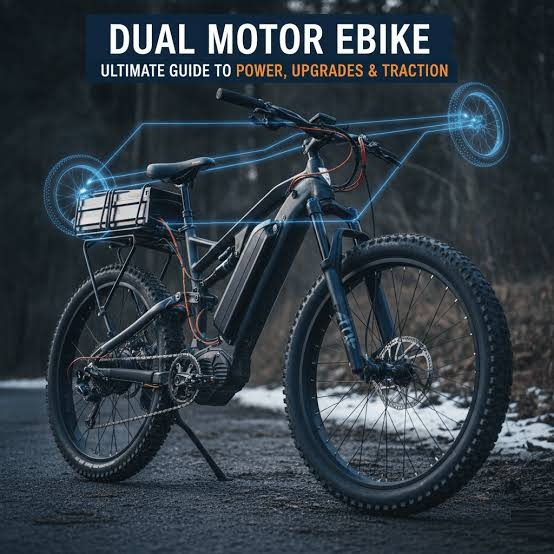
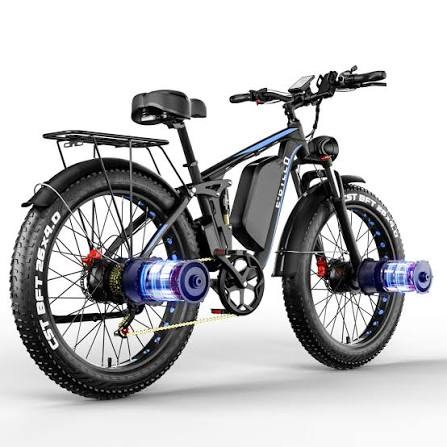
A dual motor electric bike has two electric motors, most commonly one in each wheel hub.
A typical setup looks like this:
- Front hub motor
- Rear hub motor
- Battery pack
- Motor controllers
- Pedal-assist sensor
- Display/control system
- Independent or coordinated motor control
The system can send power to both wheels simultaneously or allow the rider to use only one motor.
This is particularly useful on loose or slippery surfaces because distributing power between two wheels can improve traction.
For example, the Tuttio Adria26 provides front- and rear-motor drive modes, allowing riders to switch between rear-wheel drive and dual-drive operation depending on terrain.
How Does an Electric Bike Dual Motor System Work?
A conventional e-bike might have one 750W hub motor.
A dual-motor model could instead have two motors, such as:
1,000W front + 1,000W rear = 2,000W combined nominal/peak configuration
However, motor specifications need careful interpretation.
Some manufacturers advertise peak power, while others emphasize nominal or continuous power. Therefore, a bike advertised as a “5000W dual motor” shouldn’t automatically be compared with another manufacturer’s 5000W model without checking how those numbers are defined.
The battery and controllers also determine how much power the motors can actually receive.
Single Motor vs Dual Motor
| Feature | Single Motor | Dual Motor |
|---|---|---|
| Traction | Good | Excellent on loose terrain |
| Hill climbing | Good to excellent | Excellent |
| Acceleration | Moderate to strong | Stronger |
| Energy consumption | Lower | Higher |
| Weight | Usually lower | Usually higher |
| Complexity | Lower | Higher |
| Cost | Usually lower | Usually higher |
| Best for | Commuting and general riding | Hills, off-road and heavy loads |
Main Advantages of Dual Motor Electric Bikes
1. Better Traction
This is arguably the biggest advantage.
With front and rear motors providing propulsion, the bike can distribute traction across two contact patches rather than relying entirely on the rear wheel.
That’s valuable on:
- Sand
- Gravel
- Snow
- Mud
- Wet trails
- Loose dirt
- Steep climbs
A dual-motor fat-tire electric bike combines this traction advantage with wide tires that provide additional surface contact.
2. Stronger Hill-Climbing Performance
Two motors can provide substantially more available torque than a comparable single-motor setup.
On a steep climb, the front motor can help prevent the rear wheel from doing all the work.
This doesn’t mean every dual-motor bike can climb any hill. Rider weight, battery voltage, controller current, tire grip, gearing, temperature, and terrain all matter.
Still, for demanding terrain, dual drive can be a major advantage.
3. Faster Acceleration
A powerful dual-motor system can deliver very strong acceleration.
That’s one reason high-output models are popular among riders who prioritize performance over lightweight design.
However, acceleration should be treated as a safety consideration rather than simply a selling point. More power requires better brakes, tires, suspension, frame strength, and rider control.
4. More Control in Difficult Terrain
Imagine climbing a muddy trail.
A rear-wheel-only e-bike may spin its rear tire when traction becomes limited. With a properly controlled dual-motor system, the front wheel can contribute propulsion.
The result can be more predictable movement across difficult surfaces.
Are Dual Motor E-Bikes Worth It?
For the right rider, absolutely.
A dual motor system makes the most sense when you regularly ride:
- Steep hills
- Mountain trails
- Sand
- Snow
- Mud
- Rough gravel
- Heavy cargo
- Challenging off-road terrain
But if your typical journey is a flat 5-mile city commute, a high-powered dual-motor bike may be unnecessary.
You could end up carrying extra weight and using more battery capacity without benefiting much from the second motor.
Expert rule: Buy dual motors because you need additional traction or performance—not simply because two motors sound better than one.
Best Dual Motor Electric Bikes in 2026
The “best” model depends heavily on your intended use. High-power bikes also vary significantly in how manufacturers report motor output.
Here are several interesting examples for 2026.
1. Tuttio Adria26 — 5000W Dual Motor
The Tuttio Adria26 is one of the most recognizable examples of a high-power dual-motor fat-tire e-bike.
Tuttio lists:
- 5000W peak dual-motor output
- 52V 25Ah battery
- 210Nm peak torque
- 26 × 4-inch fat tires
- Hydraulic disc brakes
- Up to 40 mph in its detailed specifications
- 40 kg listed net weight
- 8–10-hour charging time
The manufacturer also describes multiple drive modes, including front-wheel, rear-wheel, and dual-drive operation.
One important point: Tuttio explicitly says the Adria26 is designed for off-road use and tells riders to check local laws before riding.
That distinction matters because a 5000W machine should not automatically be assumed to be a road-legal bicycle.
2. TESWAY X9 Ultra — 4000W Peak AWD
The TESWAY X9 Ultra is another high-output option marketed as a 2026 model.
Its listed specifications include:
- 4000W peak dual-motor power
- 120Nm × 2 maximum torque
- 60V 30Ah battery
- 100–120 mile claimed maximum range
- Up to 44 mph
- 400-pound maximum load
- UL 2271 and UL 2849 certifications listed by the manufacturer
Its combination of large battery capacity, dual motors, and fat tires is aimed at riders looking for high-performance all-terrain capability.
As always, advertised range depends heavily on riding mode, speed, rider weight, temperature, terrain, and wind.
3. Dakeya MX500 — 4000W Dual Motor Fat Tire E-Bike
The Dakeya MX500 targets riders who want a slightly more compact high-power platform.
Its listed specifications include:
- 4000W peak dual-motor output
- 52V 25Ah battery
- 1300Wh battery capacity
- Up to 40 mph
- Up to 65 miles claimed range
- 24 × 4-inch fat tires
- Hydraulic disc brakes
- Shimano 7-speed drivetrain
- Front suspension
The manufacturer lists the bike at 83.7 pounds and gives a maximum load of up to 400 pounds.
This illustrates an important point: high-power dual-motor e-bikes are usually substantially heavier than lightweight commuter e-bikes.
4. EcoE 5000W Dual Motor E-Bike
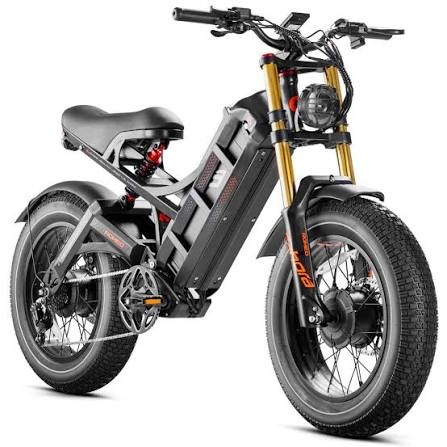
The EcoE 5000W dual-motor electric bike is another high-powered all-terrain design frequently associated with 26 × 4-inch fat tires.
Available documentation lists a 60V 32Ah removable lithium battery, 5000W high-speed brushless dual-motor system, full suspension, seven-speed gearing, and a claimed 35–80-mile range depending on riding conditions.
The manufacturer’s own testing discussion also emphasizes the trade-off between high output and energy consumption.
That is exactly what buyers should remember: more motor power doesn’t create free range.
5000W Dual Motor Electric Bike: Is It Too Powerful?
For many riders, yes.
A 5000W dual-motor electric bike is closer to a high-performance electric vehicle than a conventional low-speed commuter e-bike.
Power at this level can provide:
- Extremely strong acceleration
- High hill-climbing capability
- Strong off-road performance
- Better traction with AWD
- High-speed potential
But it also creates additional requirements for:
- Strong brakes
- High-quality tires
- Robust wheels
- Strong frame construction
- Appropriate suspension
- Large battery
- High-current controllers
- Experienced riding technique
And, critically, legal classification can change completely.
4000W Dual Motor Electric Bike vs 5000W
Don’t assume that 5000W is automatically the better choice.
| Factor | 4000W Dual Motor | 5000W Dual Motor |
|---|---|---|
| Performance | Very high | Extremely high |
| Energy demand | High | Very high |
| Battery requirements | Large | Very large |
| Weight | Usually heavy | Usually heavy |
| Off-road capability | Excellent | Excellent |
| Cost | Often lower | Often higher |
| Suitable for beginners | Depends on model | Usually not ideal |
| Legal classification | Must verify | Must verify carefully |
For many riders, 4000W provides more than enough performance.
The extra output of a 5000W system may matter mainly to riders who regularly tackle very steep terrain, heavy loads, or demanding off-road conditions.
Dual Motor Fat Tire Electric Bike: Why the Combination Works
Fat tires and dual motors are a natural pairing.
A 4-inch tire provides a broad contact patch and can be run at lower pressures for improved comfort and traction.
Combine that with front and rear motor assistance, and you get a bike designed for surfaces where a conventional narrow-tire commuter may struggle.
Common applications include:
- Snow riding
- Beach and sand riding
- Forest trails
- Hunting and outdoor recreation
- Rocky terrain
- Gravel
- Muddy trails
But fat tires also create disadvantages.
They can increase:
- Rolling resistance
- Weight
- Tire replacement cost
- Battery consumption
So don’t choose fat tires simply because they look aggressive.
Battery Size Matters More Than Motor Power
A common buying mistake is focusing entirely on watts.
A dual motor system needs sufficient electrical energy to support its performance.
Battery capacity is usually expressed in watt-hours (Wh).
For example:
52V × 25Ah = 1,300Wh
That is a large battery compared with many mainstream commuter e-bikes.
But even a 1,300Wh battery can drain quickly if two high-output motors are used aggressively.
Factors affecting range include:
- Rider weight
- Speed
- Assist level
- Terrain
- Tire pressure
- Wind
- Temperature
- Payload
- Stop-and-go riding
- Motor efficiency
Therefore, treat manufacturer range figures as estimates rather than guarantees.
Pedal Electric Dual Motor E-Bike: Does Pedaling Matter?
Yes.
A pedal electric dual motor e-bike can combine human power with assistance from one or both motors.
Pedaling can:
- Increase practical range
- Reduce battery consumption
- Improve climbing efficiency
- Give you greater control
- Make longer rides more comfortable
However, pedal-assist behavior varies between models.
Some high-power bikes prioritize motor performance, while others provide more conventional pedal-assist tuning.
If you want an e-bike that feels like a bicycle with assistance rather than a motorized vehicle with pedals, pay close attention to the control system and legal classification.
Dual Motor Electric Bike Safety
High-powered e-bikes deserve serious safety attention.
Wear appropriate protective equipment:
- Certified helmet
- Gloves
- Eye protection
- Closed-toe footwear
- Reflective clothing when appropriate
- Protective riding gear for serious off-road use
And make sure the braking system is appropriate for the bike’s weight and speed.
Battery safety is equally important. The U.S. Consumer Product Safety Commission says UL 2849 addresses electrical systems for e-bikes and has emphasized compliance with relevant safety standards because electrical-system failures can create serious fire and injury risks.
Never use an incompatible charger or damaged battery.
Are 4000W and 5000W E-Bikes Legal?
This is one of the most important sections of this guide.
There is no single worldwide definition of an “e-bike.”
In the United States, federal and state rules generally distinguish low-speed electric bicycles from more powerful vehicles. PeopleForBikes notes that the commonly used U.S. three-class framework is designed for low-speed electric bicycles, while devices exceeding applicable power or speed limitations can fall outside that framework.
In the UK, a road-legal EAPC must have pedals, a maximum continuous rated motor power of 250W, and motor assistance that cuts out at 15.5 mph. A vehicle outside those requirements can be treated as a motor vehicle.
Therefore, a 4000W or 5000W model should never be assumed to be a normal road-legal e-bike simply because the seller calls it an e-bike.
Before buying, check:
- Your country’s regulations
- State/provincial rules
- Road-use requirements
- Registration requirements
- Insurance requirements
- Helmet requirements
- Where high-power e-bikes may legally be ridden
If the manufacturer labels a bike “off-road only,” take that warning seriously.
How to Choose the Best Dual Motor Electric Bike
Use this checklist before buying.
Choose Based on Your Terrain
For flat roads, single motor may be enough.
For steep hills and loose surfaces, dual motor becomes more useful.
Check Battery Capacity
Don’t judge range from motor watts alone.
Look at:
- Voltage
- Amp-hours
- Watt-hours
- Battery chemistry
- Replaceability
- Charging time
- Warranty
Check the Brakes
High-power bikes should have strong braking systems.
Hydraulic disc brakes are common on performance-oriented models, but the exact rotor size and brake specification also matter.
Check the Weight
A 40 kg e-bike is very different from a 20 kg commuter.
Think about how you’ll:
- Store it
- Carry it
- Load it into a vehicle
- Move it up stairs
- Repair it
Check Parts Availability
Before purchasing an unusually high-power model, determine whether replacement parts are readily available.
Ask about:
- Batteries
- Controllers
- Displays
- Motors
- Brake components
- Tires
- Wheels
- Chargers
A cheap bike becomes expensive if a proprietary controller takes months to replace.
Common Mistakes When Buying Dual Motor E-Bikes
Avoid these mistakes:
Mistake 1: Choosing the Highest Wattage
More watts don’t automatically mean better engineering.
Mistake 2: Ignoring Battery Capacity
Two powerful motors can consume energy quickly.
Mistake 3: Believing Maximum Range
Range claims are usually based on specific conditions.
Mistake 4: Ignoring Weight
High-performance dual-motor bikes can be extremely heavy.
Mistake 5: Assuming “Pedals = Legal E-Bike”
Pedals alone do not determine legal classification.
Mistake 6: Ignoring the Charger and Battery
Use compatible, manufacturer-approved electrical components.
Mistake 7: Riding at High Speed Without Proper Equipment
A high-powered e-bike should be treated with considerably more respect than a low-speed commuter.
Who Should Buy a Dual Motor E-Bike?
A dual-motor model is particularly suitable for:
- Experienced e-bike riders
- Mountain and trail riders
- Riders living in very hilly areas
- Riders dealing with sand or snow
- Heavy-load users
- Outdoor enthusiasts
- Riders who need maximum traction
It may be unnecessary for:
- Flat-city commuters
- Casual recreational riders
- Lightweight-bike enthusiasts
- Riders with limited storage
- People looking for a conventional low-speed bicycle experience
Final Verdict
Dual Motor Electric Bikes offer a compelling combination of traction, torque, acceleration, and off-road capability.
A 4000W dual-motor electric bike can provide enormous performance, while a 5000W model such as the Tuttio Adria26 takes that concept even further with two high-output motors, a large battery, and 26 × 4-inch fat tires.
But the most powerful bike isn’t necessarily the best bike.
For everyday commuting, a lighter and lower-powered e-bike may be more practical. For steep hills, sand, snow, mud, heavy loads, and serious off-road riding, dual motors can make a meaningful difference.
The smartest approach is to compare motor output, battery capacity, torque, braking, weight, range, build quality, parts availability, safety certification, and local legality together.
And before purchasing any 4000W or 5000W machine, verify exactly how it is classified where you intend to ride it. In many jurisdictions, these specifications place the vehicle outside the legal definition of an ordinary bicycle.
Choose the power you actually need—not simply the biggest number on the specification sheet.
One thought on “Dual Motor Electric Bikes: Complete Guide 2026”